Posts

Critical Studies - Politics and Identity

Image
 Whether consciously or not, as creatives, we reflect the world we live in through our art with influences from the political climate and ongoing societal shifts. Personally I feel that my art is being driven by environmental concerns and the increasing pressures to live sustainably, which is why I have been trying to use natural resources and second hand materials whenever possible. Christian Boltanski, born in 1944, was a French artist and sculptor. His father was Jewish and escaped being captured by the nazis by hiding under floorboards; having grown up with this knowledge, Boltanski's work potently references the holocaust and reflects how deeply he was affected by his early experiences of wartime, shaping his life and identity. This is described in an article by Jan Garden Castro, who writes:  'For Boltanski, memory and history are dark shadows of each other – neither mirroring each other nor expressing the “truth.” '  https://sculpture.org/blogpost/1810776/349149/Ch...

Artist Research - My Inspirations

Image
Nick Rands Earthly Spheres , 1999 This work by Nick Rands features 4000 hand-shaped spheres of mud that he has collected while travelling the path of a river. I think it's amazing how many different shades there are and mud isn't something we would usually pay much attention to - let alone see beauty in - so I think Rands has done a really effective job of transforming and elevating this material into something really spectacular. They also remind me of the variety in skin colours among humans and how no two are exactly the same, but we all share the same world. It's interesting to see that there are some cooler shades among the spheres like the purplish ones, they look quite unusual and it makes me wonder what's in them that makes them so different to the rest. I found this work really relevant to my project and inspiring too - I felt really excited to work with natural materials that I'd gathered myself because I'd seen how well it worked for Nick Rands. Diggi...

Mapping Privilege Evaluation

Image
This project felt like a really good exploration of materials and making things from scratch. When we visited Newstead for the first time, the story that struck me the most was how the Mahogany furniture was a product of the slave trade, and that the felling of trees caused even further suffering when floods hit and there were no natural defences to protect native communities. The idea of flooding and taking natural resources is what lead me to the river, but first I had to research the local geology to find out if there was clay that I could dig.  Going out and discovering it was really exciting and it felt surreal to find actual clay out in the wild, I knew straight away when I saw the a redness in the earth on the embankment that there was iron rich clay there, and I want to acknowledge my partner Matt Smith who was a massive help on this expedition. I enjoyed the hands-on process of cleaning the clay, removing each little root that had infiltrated it over time. Digging the clay...

Setting up Work at Newstead Abbey

Image
When we went to Newstead Abbey to set up our work, I wanted to place mine on a mahogany surface to reference where the idea of my project originally came from. I also found that the shiny, reflective surface of the wood was a good way to highlight the crudeness of materials that I had used, and the kind of grittiness compared to the smooth table. The way the pots reflect in the glossy surface gives the objects some extra emphasis and it reminds me of water, again linking to the ideas behind the work.  They are placed in the Grand Drawing room, which also contains various pianos, a large number of ornamental furniture and large portraits hanging on the walls. It looked like a place of entertainment and indulgence, where I imagine residents and guests would engage in blissful ignorance towards how any of the luxury possessions came to be there.  

Glazing More Pots

Image
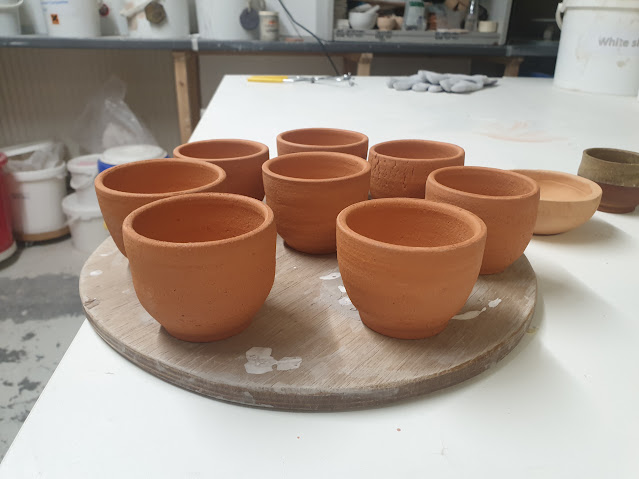
James the ceramics technician threw 8 more pots out of my remaining clay and I glazed half of them so that I have a variety of different shades, from the darker glazed ones to the lighter ones that were only fired once. There is also a size variation because the glazed ones shrink a little bit due to being fired twice, and I don't want each one to be identical because that would remove the hand-made style that I'm looking for. I really want the human aspect to be emphasised because this is what got lost Newstead's mahogany furniture - the work that went into it and the brutal suffering of the enslaved people in the Caribbean (and other areas native to the mahogany tree) is invisible.  

Ceramics Photoshoot

Image

CRITICAL STUDIES - Feminist Interventions

Image
 Auguste Renoir This painting by Renoir is a strong depiction of euro-centric female beauty standards of the era, with Venus-like red hair and 'fair' skin. Though the subject has the body of a mature woman, with a draping loose top to show this off, her face appears very juvenile with rosy cheeks and soft features, I think this is quite telling about men's ideas of the perfect woman at the time - submissive and innocent like a child, but with a sort of maternal quality. This is emphasised by the delicately painted flowers which symbolise fertility, and her hands look really small and dainty, suggesting Renoir has taken certain liberties with the anatomy according to his own ideas of beauty. This contemporary example of art about women is by the Guerrilla Girls, who challenge the norms of female representation in the art world. They create factual, graphic designs with block colour which have a straight forward message that is difficult to argue with, especially since they i...

CRITICAL STUDIES - Abstract and Process art

Image
Richard Long's work is about the process of walking in the outdoors. He gathers and presents words relating to these journeys, rather than creating images of what he can see on the walk - the text provides us with fragmented information which we string together to form a unique image in our minds. I think the list format gives the work a balanced structure because it sets a pace to the way we read it, which is one step at a time, reflecting the walking process. The marks in the background create an organic pattern like waves or a flowing river, fingerprints in the mud or contours in the sand - it feels really earthly and contrasts with the font of the text which is not in a hand-written or natural style. Personally I don't feel very inspired by this work but I think it's still a good example of process art where the outcome is not what we would expect from the artist's journey. It also brings into question what difference it makes if he really did do the walk or made it...

CRITICAL STUDIES - artists who deal with the idea of Collecting

Image
Ilya Kabakov collects large numbers of everyday objects and reconfigures them in groups. The way they are classified by type makes it seem informative and purposeful like a factual museum collection, showing how the context of objects can elevate or make them special; if the objects were displayed in the artists home or a domestic space they may be perceived as nothing extraordinary. This shot of his works reminds me of a car-boot sale or second hand shop, I think it questions where we draw the line between trash and treasure, and the way we like to hoard things throughout our lives - an everyday object might have personal meaning or memories attached but from anyone else's perspective it's just a lifeless thing.  Mike Kelley, More Love Hours Than Can be Repaid This piece by Mike Kelley is a collaged blanket made up of hand knitted toys and objects gathered from charity shops; I find this piece really powerful because each thing was once handmade as a gift to a loved one and ha...

Dog, Bear and Mahogany Motifs

Image
I'm quite interested in Lord Byron's relationship with animals and how this compares to the Taino Peoples beliefs that animals and the landscape are sacred entities inhabited by deities and ancestors. I drew lots of ideas for motifs depicting Byron's pet dogs and bear, as potential imagery to put on my ceramics or make into prints. I chose two designs that I liked best and tested them out as little Lino prints.   The face of this dog design is taken from a detail on the Taino gold figure pendant that I looked at in my research - In these next images, I have made rubbings of the Lino cuts that I made, including dog, bear and mahogany leaf motifs, which show all the marks made by cutting the Lino away at the edges. I noticed that they kind of looked like tiles and decided to do these pieces where I have made different arrangements of them and experimented with contrasting black and red. I like how you can see all the relief lines because they have a sense of energy and give t...